
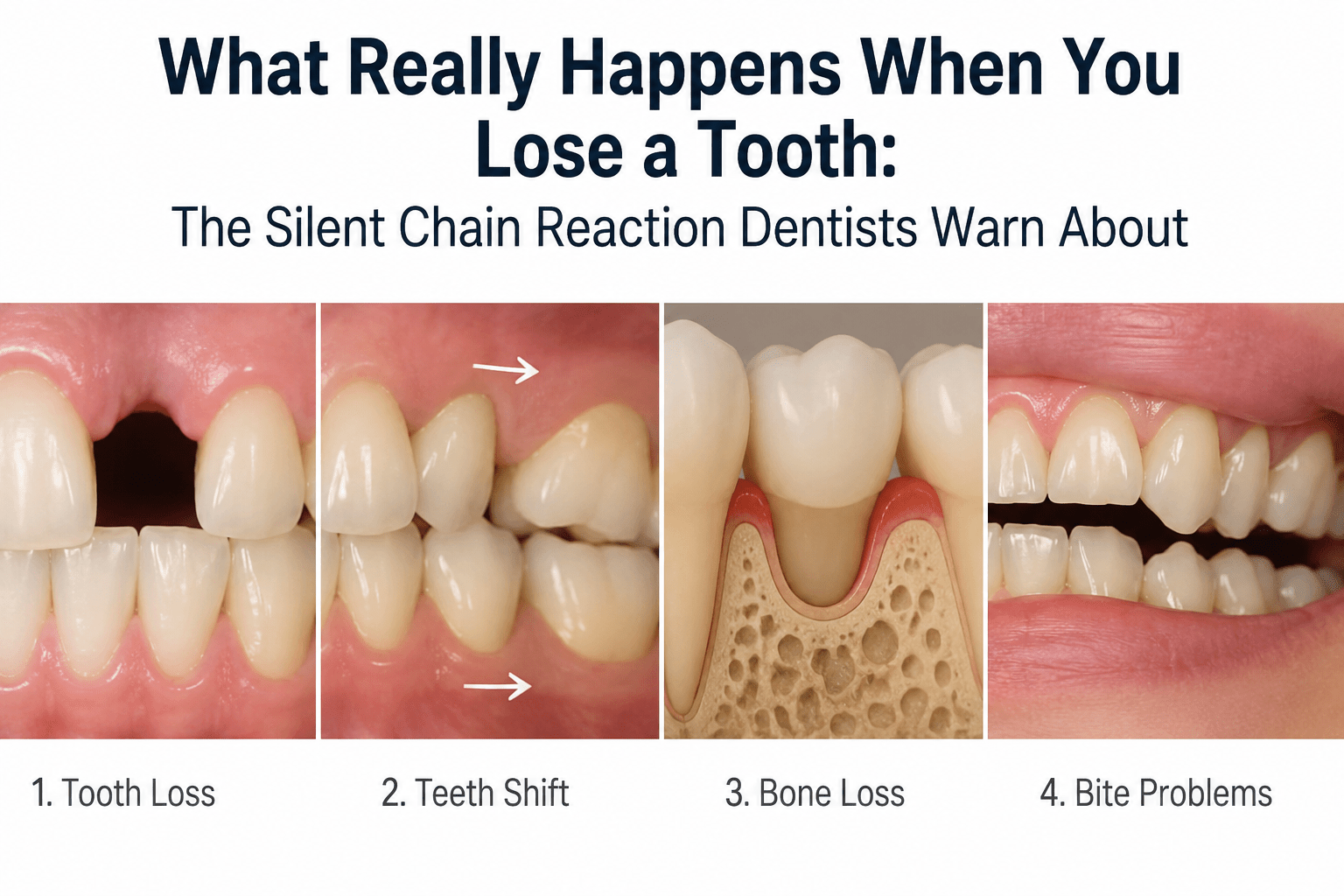
Most people who lose a tooth think the problem is simply cosmetic. You have a gap. Your smile looks different. But the consequences of missing tooth in Surat, or anywhere, go far beyond appearance. A single missing tooth sets off a chain reaction inside your jaw that affects every neighboring tooth, your bite, your jawbone, and ultimately your overall oral health. Understanding what really happens when you lose a tooth is the first step toward making the right decision about treatment before more damage occurs.
Stage One: Adjacent Teeth Begin to Drift
Within weeks to months of losing a tooth, the neighboring teeth on either side begin to tilt and drift into the empty space. This happens because each tooth in your mouth relies on its neighbors for positional support. When one tooth is removed, the structural balance is disrupted and adjacent teeth begin moving toward the gap.
This drifting causes bite misalignment, uneven pressure during chewing, and creates new spaces between the drifting teeth where food particles accumulate. These new spaces are difficult to clean properly and become breeding grounds for bacteria, leading to a higher risk of decay and gum disease in the surrounding teeth.
The longer the gap remains untreated, the more significant the drift becomes. In patients who wait several years, the drifting can be severe enough to require orthodontic intervention before any tooth replacement can even be considered.
Stage Two: The Opposing Tooth Over-Erupts
The tooth that sits directly opposite your missing tooth in the upper or lower jaw also responds to the gap. With nothing to bite against, this opposing tooth has no occlusal stop, meaning no resistance during chewing. Over time, it begins to erupt further out of the gum, a process called super-eruption or over-eruption.
An over-erupted tooth becomes longer, more exposed at the root, and increasingly difficult to restore if later treatment becomes necessary. It also creates uneven bite forces across the rest of your teeth, placing excessive pressure on specific areas and contributing to wear, cracking, and TMJ (jaw joint) discomfort over time.
Stage Three: Jawbone Loss Begins Within 12 Months
This is the consequence that most patients do not know about until it has already begun. Your jawbone depends on the stimulation provided by tooth roots during chewing to maintain its volume and density. When a tooth root is removed, the bone in that area receives no stimulation and begins to resorb, or dissolve.
According to clinical research, the jawbone begins to lose volume within the first 12 months of tooth loss. In the first year, approximately 25 percent of bone volume in the extraction area can be lost. Over five years, this loss can be dramatic enough to affect the facial structure, causing the lower face to appear sunken or prematurely aged.
Bone loss also has a practical consequence for future treatment. The longer a patient waits before getting an implant, the less bone may remain to support one. In advanced cases, a bone grafting procedure becomes necessary before implant placement can occur, adding to the overall treatment time and cost.
Stage Four: Cascade Effect on Remaining Teeth
As the drift, over-eruption, and bone loss progress, the cascade effect on the remaining teeth becomes increasingly serious. Bite misalignment causes some teeth to bear more pressure than intended during chewing, leading to accelerated wear, cracking, and even fracture of otherwise healthy teeth.
The gum disease risk increases as food impaction worsens in the shifting gaps. TMJ strain develops as the jaw struggles to function with an unbalanced bite. Patients begin to avoid chewing on one side, which further accelerates the problem on the underused side.
What started as a single missing tooth can, over years of inaction, contribute to a far more complex and expensive oral health situation. Dentists at Summirow Dental in Surat frequently see patients who delayed treatment for a single tooth and subsequently required comprehensive rehabilitation.
The Solution: A Dental Implant Stops the Chain Reaction
A dental implant is the only tooth replacement option that addresses all four stages of the chain reaction. Because the titanium implant post replaces the actual root of the missing tooth, it continues to stimulate the jawbone during function, preventing bone loss entirely. The visible crown on top restores the height and position of the missing tooth, preventing both adjacent drift and opposing over-eruption.
Unlike a dental bridge, which replaces the visible crown but not the root, an implant is a complete tooth replacement from root to tip. It preserves bone, maintains bite alignment, and protects neighboring teeth without requiring any modifications to adjacent healthy teeth.
Dr. Ushma K. Kakkad at Summirow Dental, Vesu, Surat, has placed over 5,400 dental implants and regularly sees the difference early intervention makes for a patient’s long-term oral health. The sooner you replace a missing tooth with an implant, the simpler, safer, and more economical the treatment becomes.
Frequently Asked Questions
Jawbone resorption begins within the first few months after tooth loss and becomes significant within the first 12 months. After one year, up to 25 percent of bone volume in the affected area can already be lost. This is one of the key reasons dental implants should be placed as early as possible.
Yes, implants can be placed even years after tooth loss, though a bone graft may be required first if significant bone volume has been lost. A CBCT scan at Summirow Dental, Surat, will assess your current bone levels and determine the best treatment approach.
Yes, this is a well-documented clinical phenomenon. Adjacent teeth begin to tilt and drift toward the gap within weeks to months of tooth loss. The longer the gap remains, the more significant the shifting becomes.
A dental implant is generally superior to a bridge for a missing tooth because it replaces the root and prevents bone loss. A bridge only replaces the visible crown, requires grinding down healthy adjacent teeth, and does not stop bone resorption in the gap area.
The best time is as early as possible after extraction, once the initial healing has occurred, typically six to eight weeks post-extraction. Early placement reduces the need for bone grafting and preserves the most jawbone volume.
Conclusion
A missing tooth is never just a gap in your smile. It is the beginning of a progressive chain reaction that affects every structure in your mouth over time. Jawbone loss, adjacent tooth drift, opposing tooth over-eruption, and bite collapse are all predictable consequences of untreated tooth loss. A dental implant from Summirow Dental, Vesu, Surat stops this chain reaction completely by replacing both the root and the crown of your missing tooth. Dr. Ushma K. Kakkad, with over 5,400 successful implants and ICOI USA certification, is the specialist you want managing this important decision. Call or WhatsApp 9377777303 to book your free consultation at Summirow Dental and take action before the consequences of your missing tooth compound further.
Stop Bone Loss Now — Book Your FREE Implant Consultation | Summirow Dental, Surat | 9377777303