
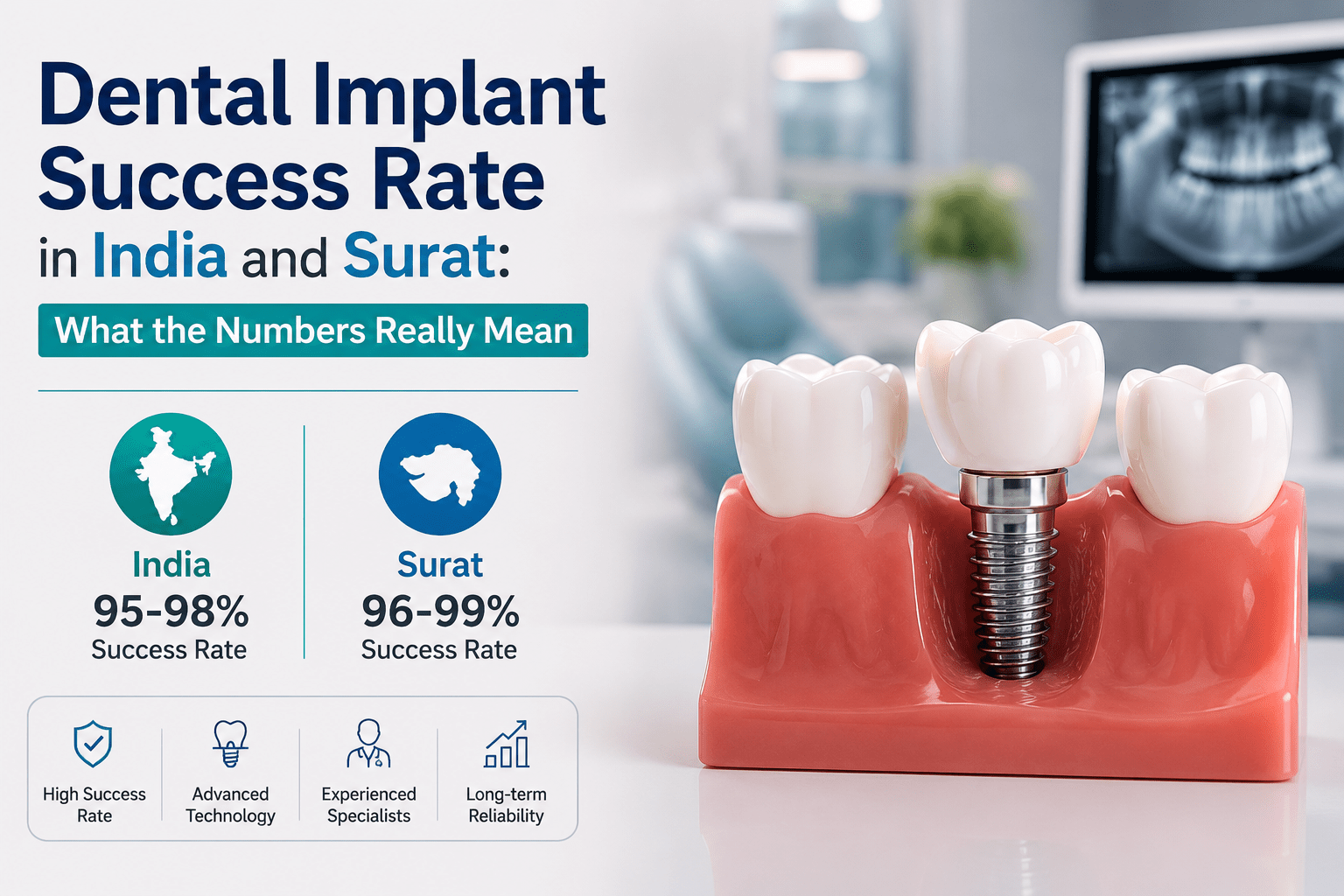
One of the most reassuring facts about modern dental implantology is its documented success rate. The dental implant success rate in India, as in other countries where premium systems and certified surgeons are used, consistently ranges from 95 to 98 percent. This figure is backed by decades of peer-reviewed clinical research. But what does a 95 to 98 percent success rate actually mean for you as a patient, and what determines whether your implant falls in the successful majority? Dr. Ushma K. Kakkad of Summirow Dental, Vesu, Surat, breaks down the numbers honestly.
What Does the 95–98% Success Rate Actually Mean?
The 95 to 98 percent success rate for dental implants refers to the proportion of implants that remain stable, functional, and in good health at follow-up periods of 10 years or longer. This means that out of 100 implants placed by a certified implantologist using premium implant systems, 95 to 98 of those implants will still be in excellent condition a decade later.
The remaining 2 to 5 percent represent cases where early or late failure occurred due to factors such as infection, poor osseointegration, systemic health complications, or heavy smoking. It is important to note that even in failure cases, the vast majority can be corrected, often with a replacement implant after the causative issue has been addressed.
Factors That Determine Whether Your Implant Succeeds
The success rate you personally achieve with your dental implant in Surat depends on a combination of clinical and patient-related factors.
Surgeon experience and technique is one of the most significant contributors. An ICOI-certified implantologist who uses CBCT-guided placement and has placed thousands of implants will achieve better outcomes than a general dentist performing occasional implant procedures. At Summirow Dental, Dr. Ushma Kakkad’s 5,400+ implants represent an extensive body of experience that directly translates into better patient outcomes.
Implant system quality, as discussed in the context of premium versus generic brands, directly affects osseointegration quality and long-term stability. Bone volume and density at the implant site are assessed before surgery to ensure adequate support. Patient oral hygiene after placement is critical for preventing peri-implantitis, the most common cause of late implant failure.
Early vs Late Implant Failure: Understanding the Difference
Implant failures are categorized as early or late. Early failure occurs within the first few months, before or during osseointegration. It is typically caused by poor bone quality, infection at the surgical site, systemic health factors, or premature loading of the implant.
Late failure occurs after the implant has successfully integrated and may be triggered by peri-implantitis, excessive bite forces, or systemic changes such as new medications or worsening health conditions. Late failure is more common than early failure and is largely preventable with regular professional maintenance and good home hygiene.
At Summirow Dental, a structured follow-up protocol and regular hygiene appointments are designed specifically to prevent both types of failure and to detect early warning signs before they progress.
Summirow Dental’s Implant Outcomes in Surat
Dr. Ushma K. Kakkad’s outcomes at Summirow Dental align with international benchmarks. Over 15 years and 5,400+ implants, the clinic maintains detailed records of patient outcomes and follow-up data. The use of premium implant systems, CBCT-guided surgical planning, and post-operative protocols designed to minimize infection risk and maximize osseointegration quality contributes to consistently strong results.
Patients at Summirow Dental are given comprehensive post-operative care instructions, follow-up schedules, and long-term monitoring. This commitment to the full patient journey, not just the surgical event, is what distinguishes a high-quality implant clinic from one focused solely on volume.
Frequently Asked Questions
The dental implant success rate in India, when performed by certified implantologists using premium international implant systems, is consistent with the global benchmark of 95 to 98 percent over 10-year follow-up periods.
The most common causes of implant failure are peri-implantitis (infection around the implant), inadequate osseointegration due to poor bone quality or systemic factors, smoking, and uncontrolled diabetes. These risks are significantly reduced by choosing a certified implantologist and following post-operative care instructions rigorously.
These terms are often used interchangeably but have a technical difference. Survival rate refers to implants still present in the mouth regardless of condition. Success rate refers to implants that are stable, healthy, and fully functional. Success rate is the more meaningful clinical metric.
In most cases, a failed implant can be removed, the area allowed to heal, and a replacement implant placed after addressing the causative issue. The success rate for replacement implants is comparable to primary placement in most cases.
Dr. Ushma Kakkad uses CBCT 3D imaging for precision placement planning, premium international implant systems, sterile surgical protocols, and a structured post-operative follow-up schedule at Summirow Dental, Surat. Her 5,400+ implants placed over 15 years reflect a consistently evidence-based approach to every case.
Conclusion
The dental implant success rate in India is one of the strongest in modern dentistry, and at Summirow Dental, Vesu, Surat, it is backed by the experience, technology, and protocols that consistently deliver outcomes in that 95 to 98 percent success range. Understanding what drives implant success empowers you to make better choices about your surgeon, your implant system, and your own role in the long-term health of your implant. Book your free consultation with Dr. Ushma K. Kakkad by calling or WhatsApp-ing 9377777303 today.
Join Our 95-98% Success Story — Book FREE Consultation | 9377777303 | Summirow Dental, Surat