
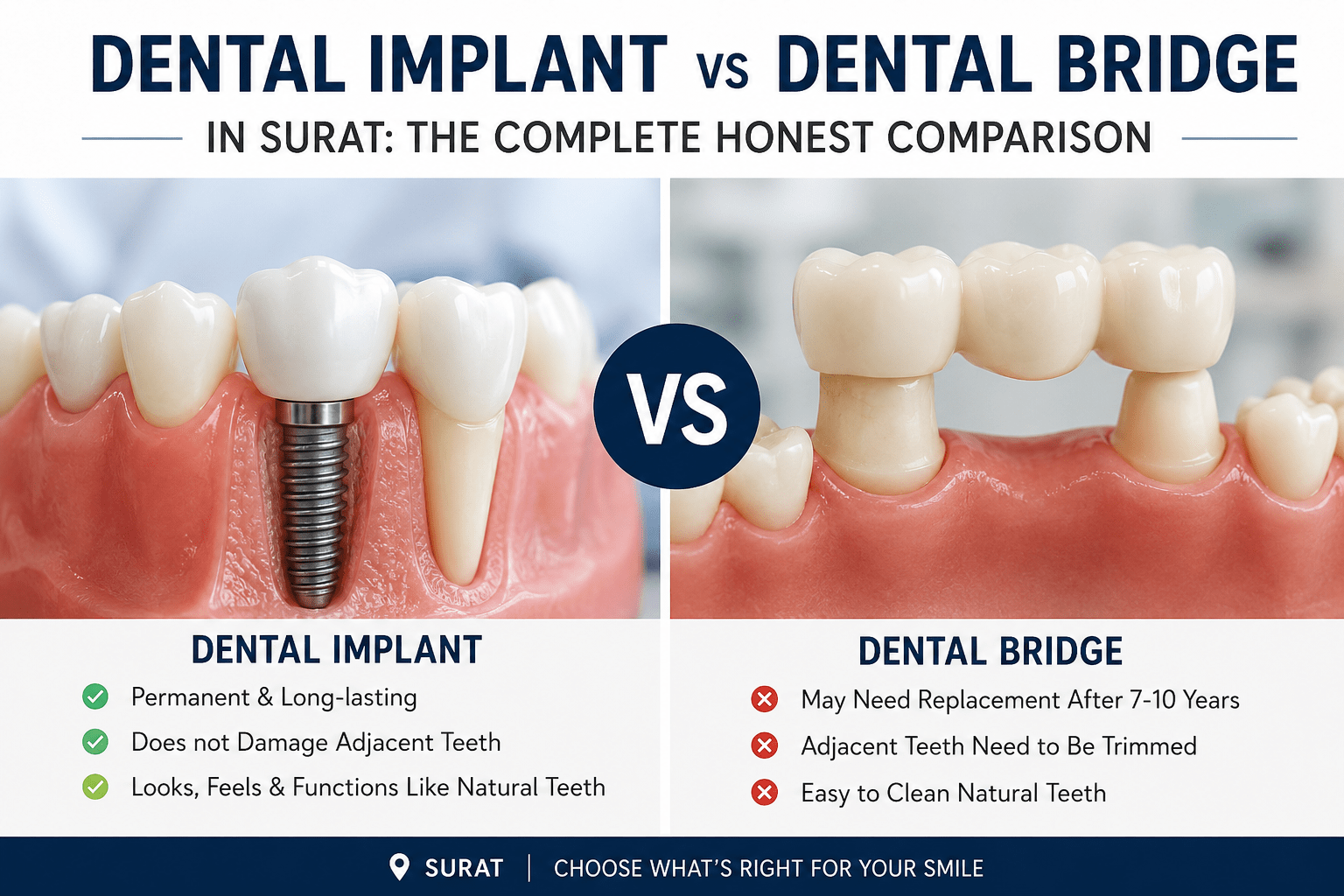
If you are missing a tooth in Surat, your dentist has likely discussed two options: a dental implant or a dental bridge. Both can fill the gap and restore your smile, but they work very differently and have very different impacts on the health of your neighboring teeth, your jawbone, and your long-term oral wellbeing. This complete comparison of dental implant versus dental bridge in Surat will help you make a truly informed decision with your dentist.
What Is a Dental Bridge and How Does It Work?
A dental bridge is a fixed prosthetic tooth that is suspended between two crowns placed on the adjacent teeth on either side of the gap. To support the bridge, the two neighboring teeth must be filed down significantly to accept the crowns, even if they are completely healthy and have no existing problems. The bridge then sits permanently in place and cannot be removed by the patient.
A traditional dental bridge does not replace the tooth root. It replaces only the visible crown portion of the tooth. Because no root replacement occurs, the jawbone beneath the bridge continues to resorb over time, which can eventually cause visible changes in the appearance of the gum and jaw in that area.
What Is a Dental Implant and How Does It Differ?
A dental implant is a complete tooth replacement system. A titanium post is placed directly into the jawbone, replacing the missing tooth’s root. After the post integrates with the bone through osseointegration over eight to twelve weeks, a crown is attached to the post above the gum line. The result is a standalone tooth that requires no modification of neighboring teeth.
Because the implant post acts as a root, it stimulates the jawbone during chewing, preventing bone loss entirely. The implant is completely self-contained and does not place any additional burden or structural stress on adjacent teeth.
Head-to-Head: Implant vs Bridge Across Key Factors
Effect on Adjacent Teeth: A bridge requires filing down two healthy adjacent teeth to serve as anchors, irreversibly removing enamel. An implant requires no modification of any neighboring tooth.
Bone Preservation: A bridge does not prevent bone loss beneath the gap. An implant actively prevents bone resorption by stimulating the jawbone.
Longevity: A dental bridge typically lasts 10 to 15 years before requiring replacement due to wear or changes in the underlying bone. A dental implant can last a lifetime with proper care.
Number of Teeth Involved: A bridge for one missing tooth involves three units — two crowns plus the bridge tooth. An implant involves only one tooth in one site.
Cleaning and Maintenance: Bridges require special floss threaders to clean beneath the bridge, which many patients find inconvenient. Implants are cleaned exactly like natural teeth with regular brushing and flossing.
Cost Over a Lifetime: While a bridge may have a lower upfront cost, the total lifetime cost, including one or more replacements and treatment for bone loss consequences, often exceeds the cost of an implant placed once and maintained for life.
When Might a Bridge Be a Better Option Than an Implant?
There are specific clinical situations where a bridge may be more appropriate. If the adjacent teeth are already damaged or decayed and require crowns regardless, a bridge may serve a dual purpose. Patients with insufficient bone who are not candidates for grafting may find a bridge more accessible. Patients with certain systemic conditions that prevent surgical procedures may also be directed toward bridge treatment.
In all other cases where implant candidacy is confirmed, the dental implant is the clinically superior option for a missing tooth replacement in Surat.
Frequently Asked Questions
A dental bridge typically has a lower upfront cost than an implant. However, bridges require replacement every 10 to 15 years and do not prevent bone loss, leading to additional treatment costs over time. When lifetime costs are considered, implants are often the more economical option.
Yes, a dental bridge requires filing down the two neighboring teeth on either side of the gap to serve as bridge anchors. This removes healthy enamel and commits those teeth to permanent crown coverage, even if they had no existing problems.
A well-made dental bridge typically lasts 10 to 15 years before it needs to be replaced. The lifespan depends on bite forces, oral hygiene, and the degree of bone resorption occurring beneath the bridge gap.
Yes, it is possible to remove an existing bridge and replace it with an implant. However, if significant bone loss has occurred beneath the old bridge, a bone graft may be required before implant placement. This is why early implant placement is always preferred.
For a missing front tooth in Surat, a dental implant is generally preferred because it provides the most natural-looking and structurally sound result without compromising the adjacent front teeth. The aesthetic outcome of an implant is superior in most cases.
Conclusion
The comparison of a dental implant versus a dental bridge in Surat clearly favours the implant for patients who qualify. It preserves bone, protects adjacent teeth, lasts longer, is easier to maintain, and provides a superior overall outcome for the long-term health of your mouth. At Summirow Dental, Vesu, Surat, Dr. Ushma K. Kakkad provides honest, evidence-based recommendations tailored to each patient’s unique clinical situation. Call or WhatsApp 9377777303 to book your free consultation and find out which option is genuinely right for your case.
Book Your FREE Implant vs Bridge Consultation | Summirow Dental, Surat | 9377777303